
How to Create the Perfect Cheese Board
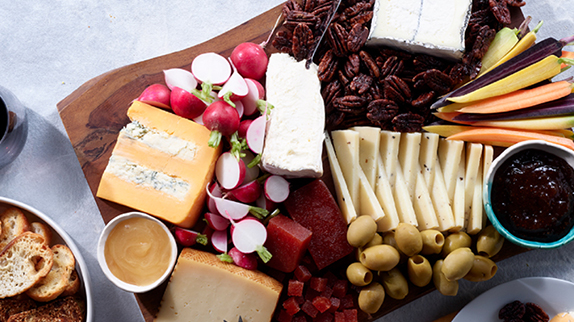
While you're always welcome to ask our expert cheesemongers for their opinion, you don’t have to be an expert to put together a well-crafted cheese plate.
"Consider a few basic reccomendations from our experts, and then let your creativity and palate guide you through our amazing array of choices."
How Much Cheese Do You Need?
Less is more when it comes to crafting a great cheese board; offering just a few varieties allows you and your guests to experience the uniqueness of each selection without overwhelming the senses. Choose three to four cheeses, and buy 1 to 1½ ounces of each for every person.
Which Cheeses Should You Choose?
Aim for a range of flavors and textures when considering a selection of cheeses for your cheese platter. Consider great cheese plates you've had in the past: they had some variety, right?
You can ask for recommendations to find specific cheese that work well together, but if you’d prefer to make the selections yourself, choose a variety of cheeses on the basis of texture: one soft, one semi-hard, and one hard. Incorporating cheeses from a variety of milks (cow, sheep, or goat) adds a nice element of variety, as well. We definitely recommend offering one familiar cheese as a non-intimidating point-of-entry for less adventurous eaters—think of a sharp cheddar or a mild brie to offset some really interesting, funky blue cheese, for instance.
If you want a great, by-the-book cheese plate, considering the following cheese board options, which work in harmony together, according to our expert staff:
Soft: Four Fat Fowl St. Stephen (Triple Crème)
Semi-Hard: Moliterno al Tartufo (Pecorino)
Hard: Piave Vecchio
Familiar: Quicke’s Smoked Cheddar
How Should You Serve the Cheese?
Bring your gourmet selections to room temperature before serving. This technique is scientifically based: because the molecules are moving more slowly, cold can genuinely mute the subtle flavors in each cheese. Spread the cheeses out on a board, and provide a separate knife for each, making sure that every wedge, wheel, or piece has enough space between them. If the cheeses get too crowded on the cheese board, they look cramped, and they also have a hard time preserving their distinct flavor and aroma.
What Should You Serve with the Cheese?
A good cheese platter includes a few breads and other accompaniments. It's a good idea to incorporate both sweet and salty accoutrements. You can choose your pairings on the basis of similarities (play up the nuttiness of our Gruyere by serving it with walnuts, for instance) or by marrying opposing flavors (like raw honey and dried apricots can balance the saltiness of blue cheese.) Be sure to provide plain-flavored bread and crackers for cheese boards as well—they won’t distract from the flavor of the cheese the way a flavorful bread can.
How Should You Store Cheese Leftovers?
If you find yourself with extra cheese leftover from your cheese board, avoid the temptation to use plastic wrap, as it can interfere with the cheese's delicate flavor. Instead, re-use the paper that the cheese was wrapped in when you purchased it. Cheese should never go in the freezer, either—it damages the flavor. Refrigerate instead to preserve its integrity.
VISIT OUR MARKETS
We have the best neighbors! Stop in and say hello. Our knowledgeable staff and friendly managers are always happy to guide you. Come visit us at any one of our locations in NYC, the Hamptons, and Connecticut!